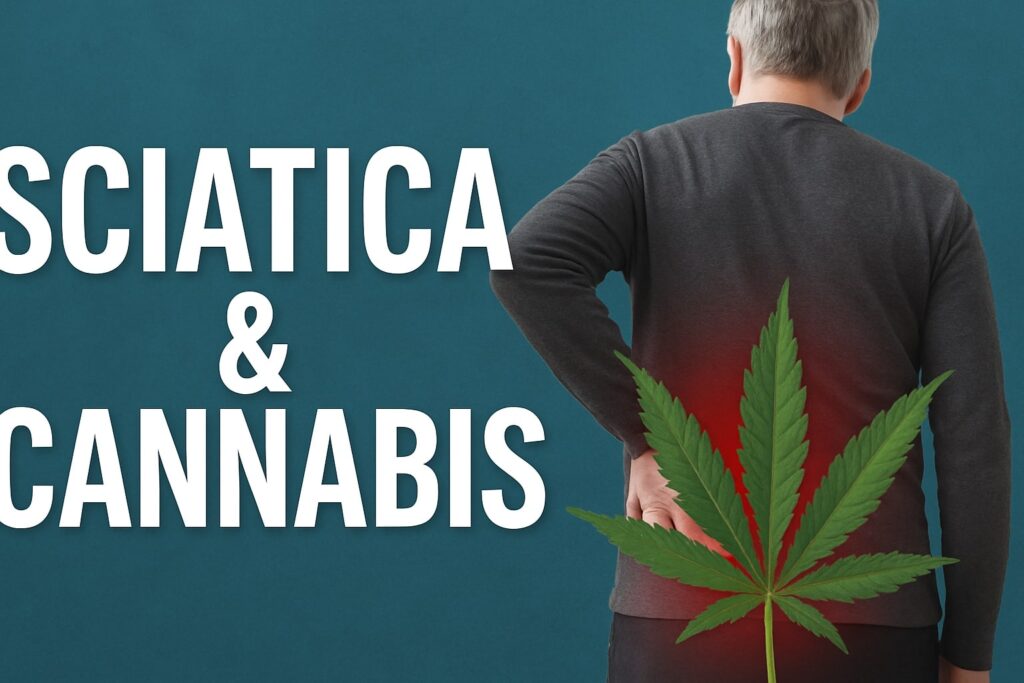
Understanding how medical cannabis may support sciatica treatment—rooted in research and reliable sources.
Understanding Sciatica
Definition & Symptoms
Sciatica refers to pain, tingling, or numbness along the path of the sciatic nerve, typically starting in the lower back and radiating down one leg. Symptoms may include sharp, shooting pain and occasionally electrical shock-like sensations Wikipedia.
Medical classification: True sciatica involves nerve root pathology (e.g., herniated disc or stenosis), distinguishing it from general lower back discomfort NCBIWikipedia.
Prevalence & Prognosis
Globally, low back pain (LBP), of which sciatica can be a part, affected 619 million people in 2020—making it the top cause of disability worldwide World Health Organization.
In the U.S., chronic pain affected 20.4% of adults, with 7.4% reporting high-impact chronic pain that restricts daily life CDC.
Lifetime occurrence of sciatica is estimated between 13% and 40%, with roughly 40% of Americans experiencing it at some point ZipDoAlmaden Family ChiropracticWikipedia.
Fortunately, about 90% of sciatica cases resolve within six weeks without surgical intervention ZipDoWikipedia.
Risk Factors & Causes
Frequent causes include herniated/bulging discs (especially under age 50) and lumbar spinal stenosis (more common in older adults) Wikipedia. Additional contributors may include muscle spasms, spondylolisthesis, or spinal masses NCBIWikipedia.
Cannabis & the Science of Relief
Mechanism of Action
Cannabinoids interact with the endocannabinoid system (ECS) by binding CB1 and CB2 receptors, which play roles in modulating pain and inflammation. Comprehensive lab studies demonstrate significant reduction in neuropathic and inflammatory pain in animal models PMC.
Clinical & Experimental Findings
A scoping review found that smoked cannabis (THC at 3.5% and 7%) reduced neuropathic pain compared to placebo; no major dose-dependent difference was noted PMC.
A trial using THC oil for radicular (nerve) pain—such as sciatica—showed a pain reduction (pain dropped from ~53 to ~35 on a 0–100 scale), outperforming placebo (~43) American Academy of NeurologyNeuroscience News.
In animal studies, THC significantly reduced hyperalgesia due to sciatic nerve injury, with CBD showing a promising trend—morphine showed no effect in that context PubMed.
A Cochrane review (2018) involving 1,750 participants across 16 studies reported that significantly more patients receiving cannabis reported ≥50% pain relief compared to controls Veriheal.
A clinical paper suggests moderate pain improvement from inhaled cannabis in peripheral neuropathy, though notes side effects like cognitive impairment and respiratory issues, especially at higher doses. Long-term safety data remain limited Cleveland Clinic Journal of Medicine.
A Harvard analysis alerts that in some trials, cannabis and placebo performed similarly, suggesting strong placebo effects or expectation bias may contribute to reported benefits Harvard Health.
Safety, Limitations & Cautions
Side Effects & Risks
Common side effects include sedation, cognitive impairment, and respiratory issues when inhaled; psychiatric symptoms may occur at high doses Cleveland Clinic Journal of Medicine.
The placebo effect may play a significant role in perceived pain relief in cannabis trials, as highlighted in recent research Harvard Health.
Evidence Gaps
While animal and small-scale human data are compelling, large, long-term, high-quality clinical trials specific to sciatica are still lacking.
Regulatory Status
CBD alone is not FDA-approved for pain treatment in the U.S. It’s approved only for certain pediatric epilepsy forms. However, Canada has authorized a 1:1 THC:CBD prescription for central neuropathic and cancer pain unresponsive to opioids Harvard Health.
Integrating Cannabis Thoughtfully
Position in Treatment Hierarchy
Cannabis is often seen as a third- or fourth-line option, used when conventional therapies (NSAIDs, physiotherapy, etc.) fail or are contraindicated Curaleaf Clinic.
Dosing & Formulation Strategy
A “start low, go slow” approach is advisable—begin with low doses and gradually increase.
Many patients prefer CBD-dominant products or balanced THC:CBD formulations to minimize psychoactive effects.
Physician Supervision
Consult a qualified healthcare provider before starting cannabis, especially if you’re on other medications or have underlying health issues.
Patient Perspectives
Real-world testimonials often highlight relief and improved function. For instance:
“A topical 3:1 THC:CBD helped more with relief than higher psychoactive blends”
(User-sourced) — suggests individualized experimentation and dosing ratios matter.Additional qualitative reports show cannabis helped with sleep quality, reduced opioid reliance, and better pain management overall.
Webpage Layout & Structure
To ensure readability and usability, here’s a suggested layout:
Hero Section
Title: Sciatica & Cannabis: Science, Evidence & Safety
Subtitle: Unpacking research-backed insights plus trusted links.
1. What Is Sciatica?
Definition, symptoms, and clarification from trusted sources (WHO, NCBI, CDC).
2. How Common Is It?
Prevalence data: global (WHO), U.S. (CDC); resolution timelines.
3. How Cannabis May Help
ECS mechanisms and supporting laboratory findings.
4. Human & Animal Evidence
Clinical outcomes (THC oil, Cochrane review, inhalation, animal models).
5. Risks & Regulatory Outlook
Side effects, placebo considerations; CBD regulatory status in U.S./Canada.
6. Practical Guidance
When to consider cannabis, dosing principles, product types, physician oversight.
7. Voices from Users
Quotes and anecdotes to humanize the data.
8. FAQs
E.g., “Can cannabis cure sciatica?”, “Which form is best?”, “How fast might I feel relief?”, “Will it affect cognition?”
9. References & Disclaimers
Link to NCBI Bookshelf (StatPearls), CDC data briefs, WHO fact sheets, Cochrane review, Harvard blog, FDA/CBD guidance.
Standard disclaimer: “This is not medical advice. Consult your doctor.”
10. Call to Action
Encourage discussion with clinicians and link to reliable resources (e.g., NIH, CDC, NCBI).
Key Government & Academic References to Link
| Source | Description |
|---|---|
| WHO: Low Back Pain Fact Sheet | Global prevalence and burden of LBP World Health Organization |
| CDC (NCHS): Chronic Pain Statistics (2019) | U.S. data on chronic and high-impact pain CDC |
| NCBI / StatPearls: Sciatica Overview | Definition and clinical features NCBI |
| Harvard Health Blog | Discussion of cannabis vs. placebo for pain Harvard Health |
| FDA/CBD Approval Info | CBD regulatory context (Harvard) Harvard Health |
